• DE
  • EN
  • „Science in 5 minutes“: Four questions for Anne Marie Bobes

    Four questions for Anne Marie Bobes

    Anne Marie Bobes from the Markgraf-Albrecht-Gymnasium in Osterburg in northern Saxony-Anhalt won the “Science in 5 Minutes” competition with her “Wind2Light” presentation. The 18-year-old recently graduated from high school and will begin studying mechanical engineering at the University of Dresden in October.

    You are currently viewing a placeholder content from Default. To access the actual content, click the button below. Please note that doing so will share data with third-party providers.

    More Information

    Ms. Bobes, please present your project briefly and in as general terms as possible.
    I am developing small wind turbines to provide a self-sufficient power supply for street lamps. In summer, this can also be achieved with solar panels, but on dark winter days it becomes difficult to ensure a reliable power supply. My rotors almost always produce enough electricity for the lanterns, even the low wind speeds generated by passing cars are enough. Over the last five years, I have developed small plastic rotors that are 50 centimeters high and 25 centimeters wide, which can be manufactured efficiently, quietly and inexpensively. They produce around five percentage points more electricity than conventional systems and enough to operate street lamps or charging stations for e-bikes.

    How did you go about it?
    First of all, I took a closer look at turbines that were already on the market, built some of them and tested them in a wind tunnel. I set up test stands in the cellar of our house and in the school cellar. My investigations showed that existing helix systems are not efficient enough for my purposes due to the enormous vortices they create. I then spent hours calculating, developing algorithms and running simulations on the computer – until my hard drive burned out. Fortunately, I was able to quickly buy a new one and design rotors, which I then produced using a 3D printer. I created various models and tested their effectiveness in a range of different basements, as well as at the Technical University of Magdeburg. I applied for a patent for my invention two years ago.

    Professorin Eva-Maria Neher © Universität Göttingen/Peter Heller

    © GDNÄ

    The winners of the GDNÄ “Science in 5 minutes” competition with their certificates (from left): Sebastian Paschen and Moritz Roloff (3rd prize), GDNÄ President Professor Heribert Hofer, Anne Marie Bobes (1st place), Felix Gross (2nd place).

    You were only 16 years old at the time. Who helped you?
    At the very beginning, it was my grandfather, in whose carpentry workshop I was allowed to build all kinds of things as a child. At school, I received a lot of support from my biology teacher Michael Müller. He gave me my first ideas and made sure that I was able to develop the idea at school. He also gave me a lot of support with the patent application. The association of friends of my school covered the application costs. The Jugend forscht competition, in which I took part for the first time when I was 13, was very important to me. With Jugend forscht, I have already been to London, Los Angeles and Thessaloniki, where I was allowed to take part in international competitions with my turbines and repeatedly came in at the top. I used the prize money to finance the next steps in the project. My first publication will soon appear in the magazine Junge Wissenschaft.

    What are your plans now?
    In a few weeks I will begin studying and I’m really looking forward to it. I hope that I can test my wind turbines in the field in Dresden and get closer to series production. Extensive tests are absolutely essential to ensure safety and efficiency. I’ve already received an offer for large-scale production, but I turned it down because the preconditions haven’t been met yet. At the same time, I want to advance new ideas. For example, I want to find out why birds fly into wind turbines so often. I am increasingly interested in biophysical questions. Professionally, I could imagine a future in aerospace. That’s why it’s great that I was offered an internship at the German Aerospace Center during the GDNÄ assembly in Potsdam. I am very happy to accept the offer.

    Professorin Eva-Maria Neher © Universität Göttingen/Peter Heller

    © Anne Marie Bobes

    Anne Marie Bobes from the Markgraf-Albrecht-Gymnasium in Osterburg in northern Saxony-Anhalt won the “Science in 5 Minutes” competition with her “Wind2Light” presentation.

    GDNÄ elects Ferdi Schüth as Vice President and future President

    GDNÄ elects Ferdi Schüth as Vice President and future President

    Professor Ferdi Schüth is the new Vice President of the German Society of Natural Scientists (GDNÄ). The Director at the Max Planck Institute for Coal Research will lead the GDNÄ as President in 2027 and 2028.
    The Society of German Natural Scientists and Physicians (GDNÄ) has elected the chemist Prof Dr Ferdi Schüth as 2nd Vice President for the years 2025 and 2026. The election took place at the General Assembly on the occasion of the 133rd meeting of the Society of Natural Scientists, which is taking place in Potsdam until Sunday, 15 September. Ferdi Schüth is Professor of Chemistry and has been Director at the Max Planck Institute for Coal Research in Mülheim an der Ruhr since 1998. As 2nd Vice President of the GDNÄ, he is firmly earmarked for the office of President in 2027 and 2028.

    “I am very much looking forward to this office,” says Professor Schüth, adding: “The various scientific fields are highly fragmented and separated from one another today. It is therefore particularly important that an integrating organisation such as the GDNÄ attempts to break down disciplinary boundaries in order to tackle overarching problems and provide mutual impetus for their solution.”

    Professor Anke Kaysser-Pyzalla, Chair of the Executive Board of the German Aerospace Centre and designated GDNÄ President for the years 2025 and 2026, says: “With Ferdi Schüth, an extremely committed and experienced scientist is joining the GDNÄ Executive Committee. As a former Vice President of the Max Planck Society and a member of many scientific organisations, he has an excellent network. I am very much looking forward to working with him.”

    Professorin Eva-Maria Neher © Universität Göttingen/Peter Heller

    © Frank Vinken für MPI für Kohlenforschung

    Professor Ferdi Schüth is the new Vice President of the German Society of Natural Scientists (GDNÄ).
    About the person

    Ferdi Schüth studied chemistry and law in Münster and earned his doctorate in chemistry. He was a postdoc at the Department of Chemical Engineering at the University of Minneapolis in the USA and completed his habilitation in inorganic chemistry in Mainz in 1995. In 1995 he was appointed to a chair in inorganic chemistry in Frankfurt and in 1998 was appointed Director and Scientific Member at the Max Planck Institute for Coal Research in Mülheim. Schüth has been an honorary professor at Ruhr University Bochum since 1999. He was Vice President of the Max Planck Society from 2014 to 2020.

    Further information

    “Science in 5 minutes” : Three questions for Felix Gross

    Three questions for Felix Gross

    At the GDNÄ Science Slam “Science in 5 Minutes”, Felix Gross came in second with his presentation on pattern recognition using artificial intelligence. The 17-year-old attends the Marienschule in Bielefeld, where he is taking advanced courses in mathematics and computer science and is aiming to graduate next year. His topic in the Science Slam was “Seeing without understanding – how AI interprets images”.

    Can you describe your topic in a few sentences?
    I presented the way in which convolutional neural networks, or CNNs for short, work. This allows certain patterns to be recognized in images, for example numbers, such as perceiving a three. Specifically, I use this method to improve chess robots. Currently, the robots don’t allow their opponent a break, even in difficult positions. My program ensures that the robot waits a little with the next move, namely for the length of time that a human usually needs to think.

    How did you come up with the topic?
    It just developed over time. As a child, I was already interested in robots. I have always been fascinated by things that do something independently. A year ago, I started working on the topic of chess.

    What are you planning to do next?
    I’m currently applying to the German national artificial intelligence competition with my program. After graduating from high school, I would like to study computer science – I don’t know yet where. After that, I want to work in AI research. If that doesn’t work out, I can also imagine taking a job in the business world.

    Professorin Eva-Maria Neher © Universität Göttingen/Peter Heller

    © GDNÄ

    At the GDNÄ Science Slam “Science in 5 Minutes”, 17-year-old Felix Gross came in second with his presentation on pattern recognition using artificial intelligence.

    Eva-Maria Neher honoured with the Alexander von Humboldt Medal

    Eva-Maria Neher honoured with the Alexander von Humboldt Medal

    At the 133rd meeting of the Society of German Natural Scientists and Physicians (GDNÄ) in Potsdam, the Alexander von Humboldt Medal was awarded to Göttingen-based Professor Eva-Maria Neher. She received the award for her scientific educational work and her special commitment as president and board member of the GDNÄ.

    Prof. Dr Eva-Maria Neher was honoured with the Alexander von Humboldt Medal at the opening session of the 133rd Conference of the Society of German Natural Scientists and Physicians (GDNÄ) on 13 September 2024 at the Griebnitzsee Campus of the University of Potsdam. At the award ceremony, the current President of the Society of Natural Scientists, Professor Heribert Hofer, highlighted the outstanding contributions of the award winner to the education of young people in the field of mathematics and science. “Eva-Maria Neher has successfully led the GDNÄ’s student programme for many years and developed it into a central part of the meetings,” said Hofer. In addition, as President and long-standing member of the Board of Directors, she has had a decisive influence on the development of the GDNÄ.

    Eröffnung der Büros Postplatz 1 © Paul Glaser

    © MIKA-fotografie | Berlin

    In her acceptance speech, the prizewinner emphasised her commitment to the GDNÄ, which she intends to continue to support with advice and assistance in the future.

    About the award

    The Alexander von Humboldt Medal honours individuals who have made an outstanding contribution to the further development of the Society of German Natural Scientists and Physicians. The medal commemorates the great natural scientist and cosmopolitan Alexander von Humboldt (1769 to 1859). He made a decisive contribution to the early development of the GDNÄ. The medal has been awarded every two years since 2010.

    Professorin Eva-Maria Neher © Universität Göttingen/Peter Heller

    © MIKA-fotografie | Berlin

    Eva-Maria Neher with the certificate for the GDNÄ’s Alexander von Humboldt Award. To her left: GDNÄ Secretary General and Treasurer Michael Dröscher (with medal), to her right GDNÄ President Heribert Hofer.

    About the person

    Honorary Professor Dr Eva-Maria Neher studied biology, biochemistry, organic chemistry and microbiology in Göttingen and received her doctorate in 1977. In 1993, she began designing and organising experimental courses in chemistry and biology at the Freie Waldorfschule Göttingen. In 2000, Eva-Maria Neher founded the XLAB – Göttinger Experimentallabor für junge Leute e.V. and headed it until 2018. She has been Chairwoman of the Board of the XLAB Foundation since 2008 and Chairwoman of the University Council of the European University of Flensburg since 2014, as well as President of the Board of the Network of Youth Excellence e.V. She has been a member of the Board and Board Council of the GDNÄ since 2013. In 2015 and 2016, she was President of the Society of Natural Scientists. Neher has been honoured many times for her social and scientific commitment.

    Interviews with Eva-Maria Neher

    Photo journal Daily impressions from the GDNÄ Conference 2024

    Photo journal

    Daily impressions from the GDNÄ Conference 2024

    The Young GDNÄ on the podium, a Nobel Prize winner during his lecture lecture, discussions during the coffee break, the ambience on the Griebnitzsee Griebnitzsee university campus: impressions of the 133rd meeting can be found on this page. A picture and a short text – here you will find brief and succinctly about highlights and nice side events. A detailed photo documentation will soon be available on this homepage.

    Thursday, 12 September 2024

    Science-Slam auf der 133 Versammlung in Potsdam

    © MIKA-fotografie | Berlin

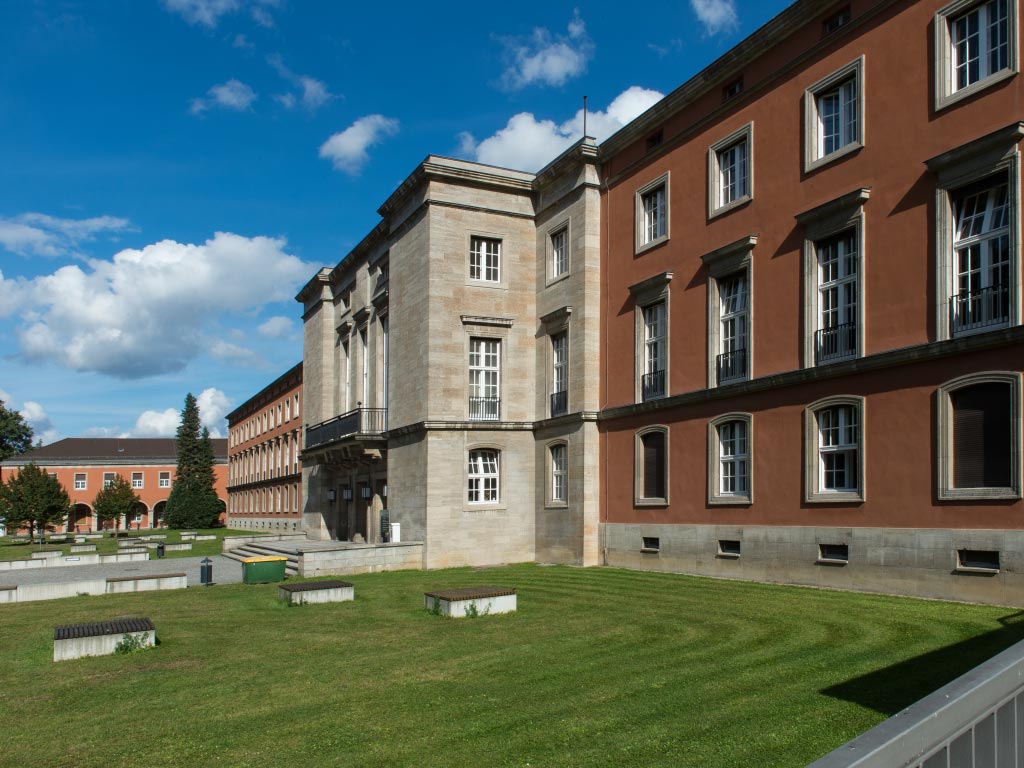
    In GDNÄ hands for four days: Lecture theatre building at the University of Potsdam in Griebnitzsee.

    Paul Mühlenhoff, der Leiter des GDNÄ-Schülerprogramms, grüßt vom Versammlungsort 2024 auf dem Campus Griebnitzsee der Universität Potsdam.

    © MIKA-fotografie | Berlin

    A crowd-puller: the GDNÄ Science Slam.

    Paul Mühlenhoff, der Leiter des GDNÄ-Schülerprogramms, grüßt vom Versammlungsort 2024 auf dem Campus Griebnitzsee der Universität Potsdam.

    © GDNÄ

    Paul Mühlenhoff, head of the GDNÄ student programme, greets from the 2024 meeting venue on the Griebnitzsee campus of the University of Potsdam. Here, more than a hundred students prepare their performances at the conference.

    Science-Slam auf der 133 Versammlung in Potsdam

    © MIKA-fotografie | Berlin

    Science is fun: A look into the audience at the ‘Science in 5 minutes’ competition

    Science-Slam auf der 133 Versammlung in Potsdam

    © MIKA-fotografie | Berlin

    Science in 5 minutes: In a packed lecture theatre at the University of Potsdam, ten pupils and students gave their presentations to be judged by the audience. The topics ranged from innovative wind turbines and laboratory meat to the neglect of diversity in medicine. GDNÄ President Heribert Hofer (on the podium) moderated the evening event.

    Science-Slam auf der 133 Versammlung in Potsdam

    © MIKA-fotografie | Berlin

    GDNÄ President Heribert Hofer with the acoustically determined winners of the ‘Science in 5 Minutes’ competition. The decisive factor was the intensity of the applause from the audience, which was also measured by app for the first time. In the centre, first-placed Anne Marie Bobes (18), who presented her project ‘Wind2Light’, to the left of medical students Sebastian Paschen and Moritz Roloff (‘Sick Systems – In Search of Fair Healthcare’, 3rd place). 17-year-old Bielefeld student Felix Gross (right) came second with his contribution on pattern recognition using artificial intelligence.

    Science-Slam auf der 133 Versammlung in Potsdam

    © MIKA-fotografie | Berlin

    Science is fun: A look into the audience at the ‘Science in 5 minutes’ competition

    Science-Slam auf der 133 Versammlung in Potsdam

    © MIKA-fotografie | Berlin

    Michael Dröscher, Treasurer and Secretary General of the GDNÄ, with participants of the student programme.

    Science-Slam auf der 133 Versammlung in Potsdam

    © GDNÄ

    Anne Marie Bobes wowed the audience with her development of a wind turbine for street lamps.

    Science-Slam auf der 133 Versammlung in Potsdam

    © MIKA-fotografie | Berlin

    Deep-sea biologist Dr Stefanie Kaiser was connected via video and captivated the audience with a report on the ‘Aleut Bio’ expedition to the Northwest Pacific.

    Friday, 13 September 2024

    © GDNÄ

    Sought-after discussion partner: Nobel Prize winner Ben L. Feringa – during the coffee break, surrounded by young people .

    © MIKA-fotografie | Berlin

    Professor Eva-Maria Neher from Göttingen is being honored with the Alexander von Humboldt Medal for her great services to the GDNÄ. To her left is the speaker, Professor Michael Dröscher, and to her right Professor Heribert Hofer.

    © MIKA-fotografie | Berlin

    Lively and entertaining: Professor André Bardow from ETH Zurich in his plea for a sustainability strategy to transform the industry.

    © MIKA-fotografie | Berlin

    Nobel Prize winner Ben Feringa during his lecture “The art of building small”, in which he explains the structure and function of molecular machines.

    © MIKA-fotografie | Berlin

    Professor Katharina Kohse-Höinghaus with Junge-GDNÄ members.

    © MIKA-fotografie | Berlin

    The birth of the Young GDNÄ: On the morning of September 13, 2024, GDNÄ President Heribert Hofer announces the founding of a youth organization of his research society.

    © MIKA-fotografie | Berlin

    The working group on computer science of the Junge GDNÄ discusses cyber-physical systems and large generative language models such as ChatGPT with the speakers. The round table is being moderated by Professor Peter Liggesmeyer.

    © MIKA-fotografie | Berlin

    Members of the Young GDNÄ discuss with the speakers of the technology session under the moderation of Professor Katharina Kohse-Höinghaus.

    Saturday, 14 September 2024

    © MIKA-fotografie | Berlin

    Fully booked Science & Technology Café on the topic of “Storage of renewable energies: What solutions does chemistry offer?”

    © MIKA-fotografie | Berlin

    Professor Caroline Gutjahr discusses her lecture “Secret helpers underground: How plants work together with mycorrhizal fungi” with conference participants.

    © MIKA-fotografie | Berlin

    Questions upon questions about the astonishing placebo effect: Toxicology Professor Bernd Kaina from the Mainz University Medical Center (with microphone) pointed out the possible limits of placebo drugs.

    GDNÄ-Tagung 2024 in Potsdam: Ben Feringa © GDNÄ

    © GDNÄ

    Relaxing after a long day at the conference: Ben Feringa in one of Potsdam’s excellent Italian restaurants.

    © MIKA-fotografie | Berlin

    Exciting, but also challenging: young audience in the biology session.

    © MIKA-fotografie | Berlin

    Professor Wolfgang Lubitz during his introduction to the chemistry session he organised on Saturday morning.

    © MIKA-fotografie | Berlin

    Professor Holger Puchta presents the CRISP7Cas gene scissors and discusses current political developments.

    © MIKA-fotografie | Berlin

    The public Leopoldina lecture will be given by GDNÄ Vice President and pharmacology professor Martin Lohse on the topic of “Placebo or therapy with nothing”. Martin Lohse stepped in at short notice because the originally planned lecture by Professor Liane Benning on the results of current Arctic research could not take place.

    © MIKA-fotografie | Berlin

    Great enthusiasm for discussion: Young conference participants surround Martin Lohse after his presentation.

    Sunday, 15 September 2024

    © GDNÄ

    Sunny last day of the meeting: the Griebnitzsee campus is still firmly in GDNÄ hands.

    © GDNÄ

    Light impression from the lecture hall where lectures and discussions of the GDNÄ meetings took place.

    © MIKA-fotografie | Berlin

    Quantum computers: state of the art – this was the topic of the lecture by Professor Frank Wilhelm-Mauch from Forschungszentrum Jülich.

    © GDNÄ

    Magnetic navigation, quantum computers, new materials: the physics lectures offer plenty to discuss.

    © GDNÄ

    Sunny last day of the meeting: the Griebnitzsee campus is still firmly in GDNÄ hands.

    © MIKA-fotografie | Berlin

    Self-healing concrete, biological robot drives, drug depots that replenish themselves independently: Professor Wilfried Weber (left, back) was bombarded with questions after his lecture on living materials.

    © MIKA-fotografie | Berlin

    The fascinating magnetic navigation system of animals provided plenty to talk about after the lecture by Professor Michael Winklhofer (left).

    © GDNÄ

    Charité Professor Ursula Müller-Werdan talks about facts and myths about healthy living and ageing.