Is organocatalysis used in industry today?
Yes, in many fields, including the production of medicines. One example is darunavir for the treatment of HIV. The active ingredient, a so-called protease inhibitor, prevents the AIDS virus from multiplying in infected people. The World Health Organisation has included it on the list of essential medicines.
Is more public funding needed for catalysis research?
Yes, that would be money well spent. At present, we are lagging behind in artificial intelligence, quantum and fusion technologies, far behind the US and China. Catalysis is not as popular, but it represents a major opportunity for Germany. We have a long tradition in this field and a great deal of expertise in the country.
Let’s take a look back: how did you come to become a chemist?
It all began when I was eleven years old. Together with two friends, I had set up a small laboratory in a basement in Frankfurt; we bought the necessary chemicals from a local chemist. At that time, I wasn’t yet taking chemistry lessons. Later, I had a few gifted teachers who encouraged me. But by then my interest in the subject was already very strong, and no teacher could have steered me away from that path.
The GDNÄ has its own youth organisation, the jGDNÄ. Is there anything you would advise young people interested in the natural sciences?
Follow your passion! Don’t let yourselves be swayed, even if your parents say: ‘I see you as a lawyer or a doctor.’ There are good career opportunities in the natural sciences, both in academia and in industry. The world has recognised how important research is. And it’s a stroke of luck if you’re interested in it. It gives me immense pleasure to be able to unlock a few of nature’s secrets and perhaps change the world in the process.
On 19 September, you will be giving the public Nobel lecture on the topic of ‘Organocatalysis for our world’ at the GDNÄ meeting in Bremen. What prior knowledge is needed to follow your talk?
An interest in the subject should suffice. I try to speak as clearly as possible.
What message do you want to convey to your audience?
Organocatalysis can be both basic research and application. Both are fascinating, and that is what I want to convey. And in doing so, I’d also like to promote the Max Planck Society a little. Its outstanding basic research is well known to many, but not everyone realises that it is also the most successful start-up organisation in this country. I have one more message: enthusiasm for what you do is important. Whether in research or in other areas of life.
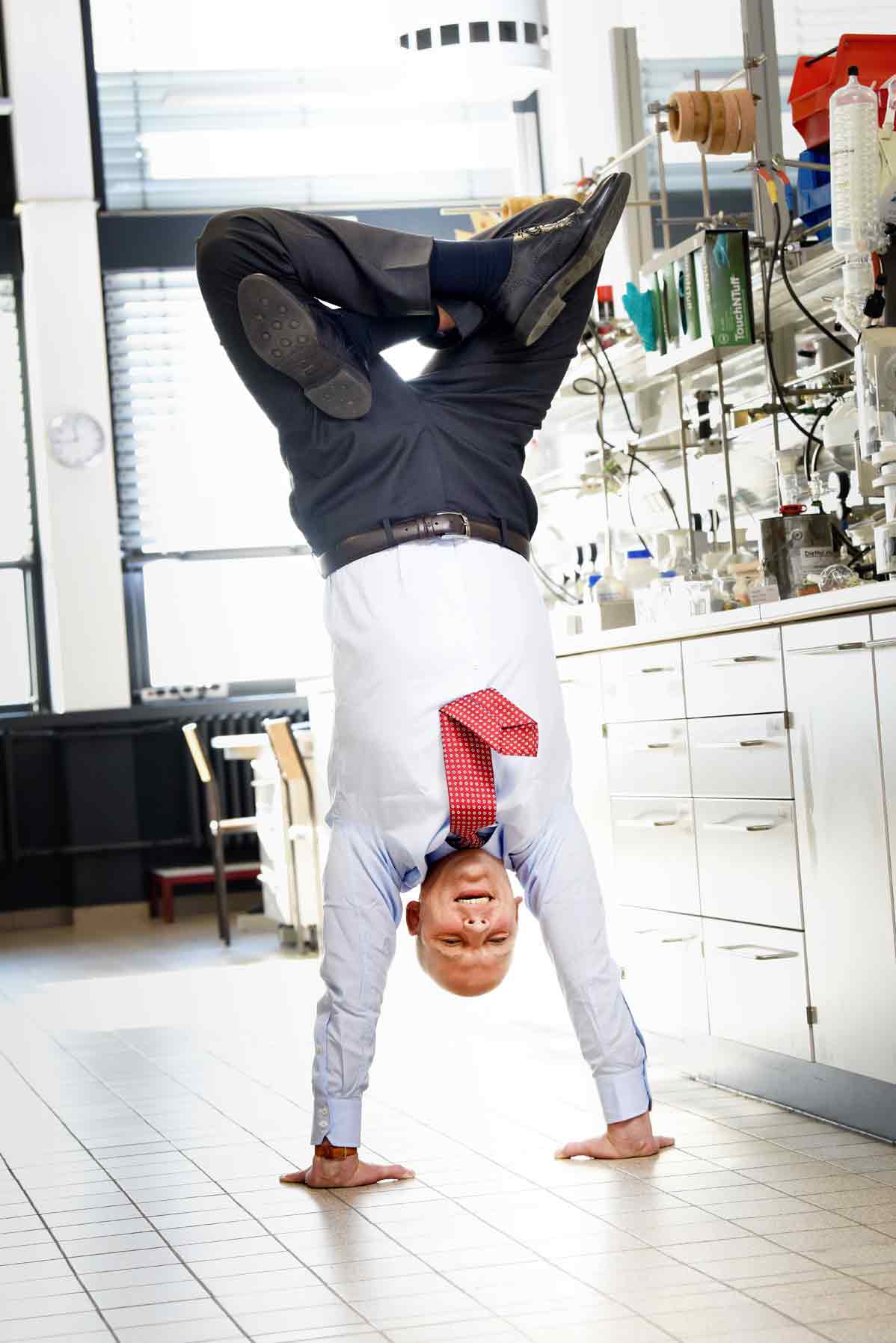
To conclude, may I ask you about a particular photo showing you standing on your hands with your legs crossed in the laboratory? How did that come about?
The photo was taken a few years before the Nobel Prize, during an interview with my fellow student Catarina Pietschmann, who works as a freelance journalist in Berlin. ‘You have to swim against the tide now and then,’ I’d said during the conversation, ‘maybe even stand on your head.’ That’s how the idea for the handstand in the lotus position came about. My wife was in the lab at the time; she held me up. I can’t manage a handstand on my own just yet.
Do you practise yoga?
Yes, yoga is important to me for keeping my mind fresh. I’ve been doing it for many years, one to two hours a day and mostly without instruction. I’ve got the hang of it a bit now.