“We still have lots of good ideas”
Michael Dröscher, Secretary General and Treasurer of the GDNÄ, talks about new momentum for the society, highlights of the meeting in Bremen and his own plans for the future.
Professor Dröscher, we are conducting this interview at the beginning of 2026. You have long been responsible for the Society of German Natural Scientists and Physicians: for eleven years as its Secretary General and for nine years as its Treasurer. Where does the GDNÄ stand today?
Not only are membership numbers stable, we can even hope for growth. This positive trend is by no means a given. Most scientific societies today are struggling with declining membership numbers and often lack young talent. This was also the case for us for a long time.
What led to the turnaround?
The decisive factor was the founding of the GDNÄ’s Young Network, known as jGDNÄ for short. The network is open to scientists and medical professionals up to the age of 32 and is developing splendidly. The first self-organised congress took place in Heidelberg in June 2025, and the next one is planned for 2027. The young members are very committed and are bringing new momentum to our venerable society.

© MIKA-fotografie | Berlin
How do they manage that?
For example, they are active on our LinkedIn channel, which operates under the name “Gesellschaft Deutscher Naturforscher und Ärzte” (German Society of Natural Scientists and Physicians). I recommend that all members take a look and become followers. We also owe the jGDNÄ a debt of gratitude for bringing us the attention of YouTuber and author Jacob Beautemps, whom we awarded the Oken Medal in December for his outstanding contributions to science communication. The young members are currently in the process of establishing regional structures, with groups in Aachen, Heidelberg, Bochum and Greifswald. Together, we have drafted rules of procedure that define the rights and obligations of the jGDNÄ. The rules are to be adopted at the next meeting in Bremen.
What motivates these young people?
I believe they sense that we are happy to have them here. We give them a lot of freedom and involve them wherever possible. For example, representatives of the jGDNÄ always attend board meetings. Many appreciate the contact with established GDNÄ members and take advantage of the opportunities for further training. For example, we are currently developing a pilot project on medical communication with two-day workshops for our young people. The format fits in well with the theme of Science Year 2026, “Medicine of the Future”.
Most members are older than 32. What are your arguments for keeping this group in the GDNÄ? And for attracting new members from this age group?
There are a number of good arguments. Every membership fee, every donation and every bequest supports young people in the natural sciences and medicine, whether in our school programme or in the jGDNÄ. The contributions finance our small but highly efficient office, which makes our many activities possible in the first place. I am thinking, for example, of the Lorenz Oken Medal award ceremony at the Science Forum in Stuttgart, which was very well attended and raised our profile among important target groups . With our website and videos of lectures at the meetings, we contribute to science communication – all of which, of course, costs money. In addition, our members benefit directly from discounts, for example at the meetings and when subscribing to our association’s journal, the Naturwissenschaftliche Rundschau. They are also invited to our regional meetings, which we now want to offer more frequently.

© MIKA-fotografie | Berlin
A regional meeting took place in Leipzig in the summer of 2025. What happens next?
The Leipzig meeting was a good start. On 13 March, we will continue the series in Bremen; the invitations have been sent out recently. Our scientific director for the next GDNÄ meeting, Professor Michal Kucera, will give a lecture on his climate science research and discuss it with the participants. The event will be hosted by the German Research Centre for Artificial Intelligence in Bremen. Further regional meetings are in the planning stage.
The 134th GDNÄ meeting will take place from 17 to 20 September. How far along are the preparations?
The programme (pdf) is set, and preparations are in full swing. Once again, we have some fantastic lectures and a superb accompanying programme. One highlight is sure to be the public lecture by Professor Ben List, winner of the 2021 Nobel Prize in Chemistry, on the evening of 19 September. The public is also invited to attend the lecture by Professor Thomas Zurbuchen from ETH Zurich on the subject of aerospace. He will speak on the eve of the opening, when we will also be hosting the popular Science Slam “Science in 5 Minutes”. The Bremen Senator for Science will give a welcoming address at the opening event. We have once again organised a programme for school pupils, with around 100 pupils from the region and around 50 students taking part. A poster exhibition is planned in the foyer, with prizes for the two best posters. Speaking of which, we will once again be awarding the Alexander von Humboldt Medal for outstanding services to the GDNÄ, and the Society of German Chemists will be presenting the Liebig Medal. The jGDNÄ is organising a student café on its own for the first time. It will be a compact gathering, with all events taking place on one level. The Congress Centre is only a ten-minute walk from the centre of Bremen. One more thing: this time, the closing speech will really be given on Sunday lunchtime so that everyone can get home on time.
It will be your last meeting as Secretary General. Why is that?
I am approaching eighty and am gradually retiring from my honorary positions on boards of trustees and other committees of scientific institutions. My position as GDNÄ Secretary General will be taken over by Professor Stefan Buchholz, with whom I have attended many events over the past few months. I will remain GDNÄ Treasurer until the end of 2027. My term as Chairman of the Administrative Board of the Max Planck Institute for Coal Research will also last until then. After that, I look forward to spending more time with my family and enjoying a more peaceful life.
How do you see the future of the GDNÄ?
As I said, the trend is positive – now we must do everything we can to ensure that it continues. The GDNÄ has held its own in the world of science for 204 years, experiencing heyday and weathering crises. Today, even large scientific societies are fighting for the attention of the public, which does not make things any easier for us. But we have many good ideas that we would like to implement and for which we need funding. As treasurer, I will therefore never tire of appealing to the generosity of our members. It is money well spent, and I vouch for that with my name.
© MIKA-fotografie | Berlin
About the person
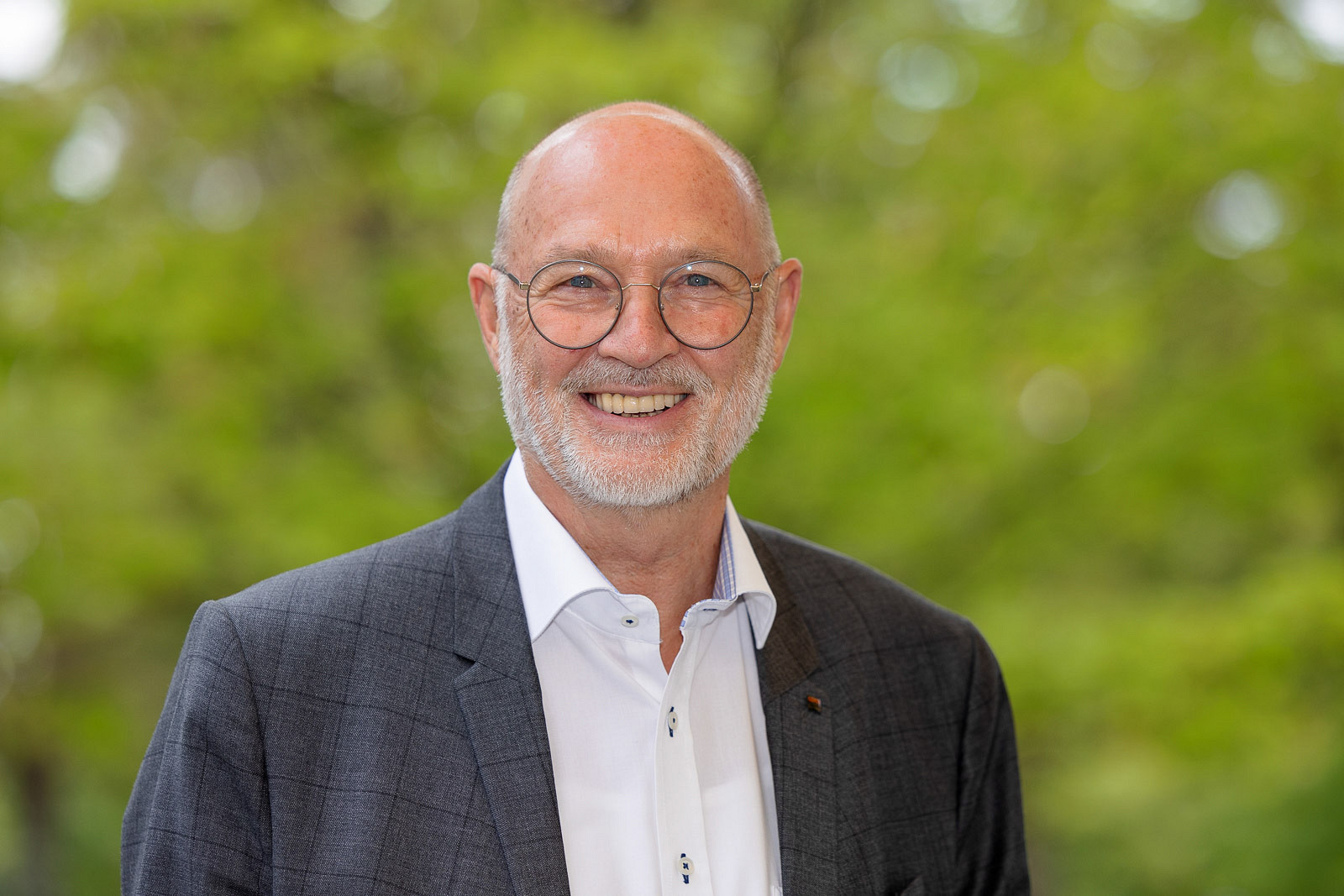
Professor Michael Dröscher has been treasurer and board member of the GDNÄ since 2017 and its secretary general since 2015. He was born in Kirn an der Nahe in 1949, studied chemistry in Mainz and also completed his doctorate there. He then took up a position as a research assistant at the University of Freiburg and, at the age of just 31, qualified as a professor in macromolecular chemistry. He continued his academic career first as a private lecturer and, from 1988, as an adjunct professor at the University of Münster.
Michael Dröscher is even more interested in the application of scientific results than in basic research, which is what led him to industry. He started in 1982 as a laboratory manager and in 1984 as a department head at Hüls AG in Marl, North Rhine-Westphalia. He remained at Hüls and its successor companies, Degussa-Hüls and Evonik-Industries AG, for 27 years in various roles. In 1997, Michael Dröscher was appointed managing director of the then newly founded Hüls subsidiary Creavis Gesellschaft für Technologie und Innovation mbH. Five years later, in 2002, Michael Dröscher became innovation manager at Degussa AG, which later became part of Evonik.
Michael Dröscher was also involved in professional associations, including as Chairman of the German Bunsen Society (2005 to 2006) and, from 2010 to 2011, as President of the German Chemical Society and Manager of the CHEMIE.NRW cluster.
He is Chairman of the Board of Directors of the Max Planck Institute for Coal Research in Mülheim and has been a member of several boards of trustees and advisory boards of the Max Planck Society, the Leibniz Association and university institutes.

@ M3B GmbH