“The nearest coral reef is on my doorstep”
Erlangen-based palaeontologist Wolfgang Kießling will reveal what prehistory can teach us about the future at the 2026 GDNÄ conference in Bremen.
Professor Kießling, could you please use an example to explain how data from Earth’s history can help us overcome future challenges?
Let’s take the currently hotly debated question of which species are particularly threatened by climate change. My field of expertise can help provide an answer here. Fossil finds show us that species living at the poles or at the equator are most at risk. A mass extinction of species is least likely to occur in the mid-latitudes.
So are we on the safe side here in Germany and Europe?
We still have the advantage, but we are by no means absolutely safe. Even in our regions, climate-induced species migration towards the poles can currently be observed. This affects organisms for which their native habitats are becoming too warm. They are moving to regions that were previously too cold for them but now offer favourable conditions as a result of global warming. If temperatures continue to rise, we can expect an increase in these shifts in distribution.
© W. Kießling
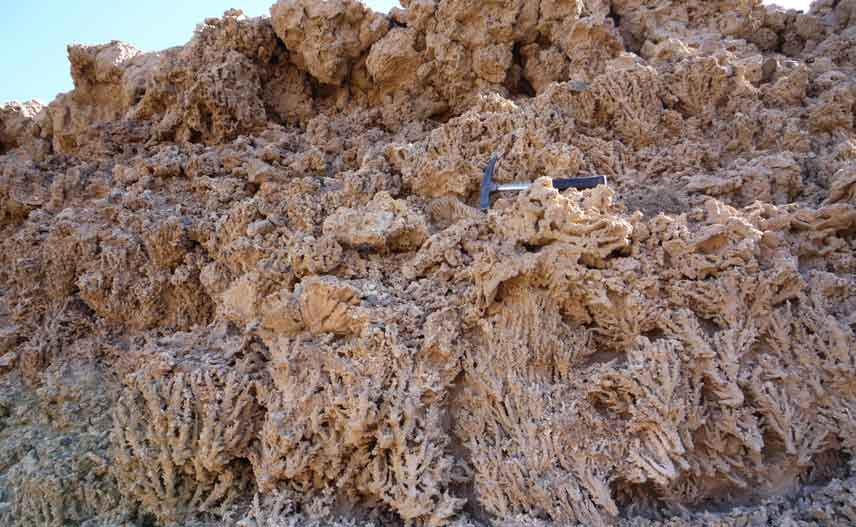
A fossilised coral reef on the Red Sea coast.
Which species can adapt well, and which are particularly sensitive to climate stressors?
Snails and oysters are relatively resilient. Fish fall somewhere in the middle. And corals are very sensitive.
Climate change has always existed and, in one way or another, the Earth has coped with it – that is the argument put forward by climate sceptics. How do you respond to that?
Yes, throughout Earth’s history there have been repeated heat waves leading to mass extinctions. It is also true that the Earth has recovered from them. However, that recovery took millions of years. During the heat-induced mass extinction at the end of the Permian period, which ended 250 million years ago, more than 80 per cent of all species became extinct. Back then, it took five million years for biodiversity and the functionality of ecosystems to be restored.
How do you know this so precisely?
We base our findings on careful scientific analyses of a vast number of prehistoric finds. Most of these findings are freely accessible online in the non-commercial Paleobiology Database, which provides information on more than two million fossil finds from all over the world. I first came across the database during my postdoctoral research in Chicago. Back then, it was still a very small project. Today, it is run by around four hundred scientists, mostly on a voluntary basis, and has more than 550 official publications to its name.
Your role as lead author at the Intergovernmental Panel on Climate Change (IPCC) from 2017 to 2023 was also on a voluntary basis. What was your seven-year stint there like?
I was a lead author for the Intergovernmental Panel on Climate Change’s Sixth Assessment Report and was responsible for one of three working groups. My group focused on the impacts of climate change, adaptation to it and vulnerabilities. I contributed data from palaeontology. For me, those were very inspiring years, but also an incredible amount of work. We lead authors had to sift through and evaluate mountains of literature in order to be able to make robust statements on climate adaptation in the assessment report. I often flew around the world for meetings with colleagues; nowadays, discussions usually take place online. Each working group comprised almost three hundred scientists, who ultimately published a report totalling nine thousand pages, plus a synthesis report. A work like this is intended for the archives; nobody reads it all the way through. For politicians and the interested public, the key messages are always summarised – which is very useful.
© Carola Radke, Museum für Naturkunde Berlin
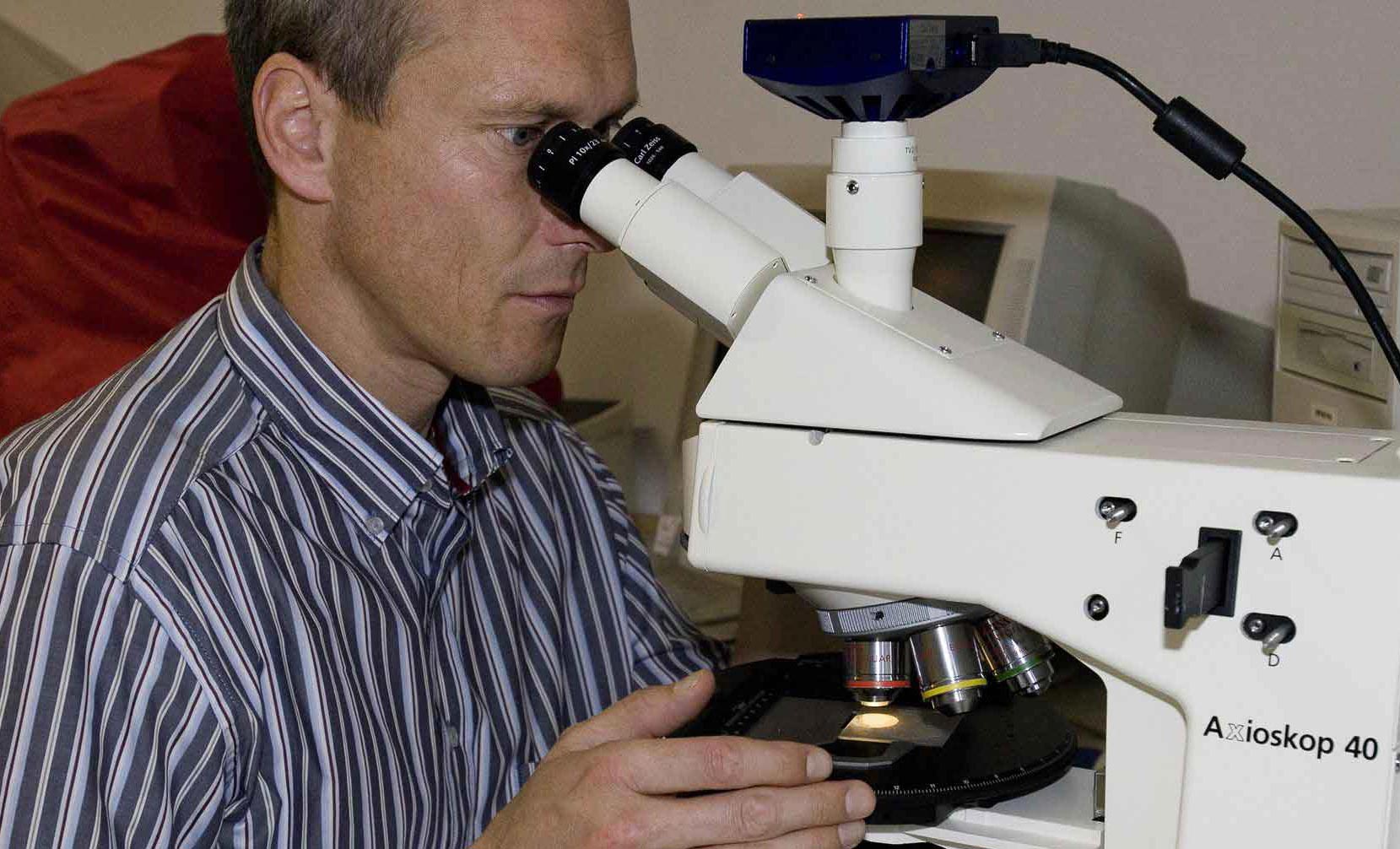
Using a polarising microscope, Wolfgang Kießling examines wafer-thin rock samples, known as thin sections, to determine their exact composition, geological history and mechanical properties. The photo was taken during Kießling's time as a professor in Berlin.
Climate change has now receded into the background as a topic of public debate. How do you feel about that?
It is frustrating, but not surprising given the many global crises. However, the problem will not go away if we ignore it. Climate change is advancing rapidly and is already causing massive damage worldwide. At the moment, I see strongly contrasting trends, for example in China. The country emits extremely high levels of greenhouse gases, yet at the same time it is very active in combating climate change and expanding renewable energy. In China – and, fortunately, elsewhere in the world too – scientific findings are certainly being incorporated into political decisions. That gives cause for hope.
When it comes to the effects of current global warming on ecosystems, there is repeated talk of imminent tipping points. How reliable are such predictions?
Predicting tipping points is extremely difficult. For coral reefs – my area of specialisation – there have been numerous such predictions, and so far none have come true. I’m very sceptical about this and don’t believe the reefs will disappear completely, as is occasionally warned. Many reefs are currently in a poor state, but in some parts of the world they are still largely intact. This applies, for example, to the Red Sea, but also to Indonesia, even though dynamite fishing is still practised there in some areas. The situation is likely to be different with the Gulf Stream, which gives Northern Europe a relatively mild climate. In that case, I consider tipping points to be entirely realistic.
© W. Kießling
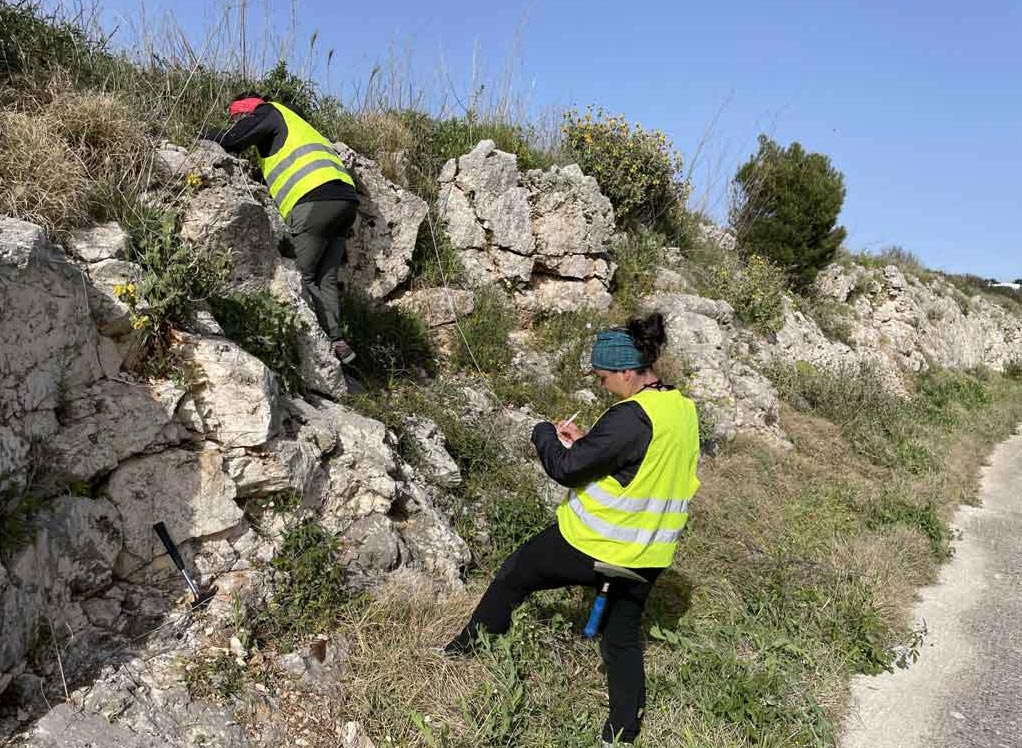
Field research on a fossilised coral reef in Apulia.
What do you make of the sensational prediction by a Chinese research group that a change in the average global annual temperature of 5.2 degrees Celsius will inevitably lead to mass species extinction?
The study is reputable and has also been included in the latest World Climate Report. However, the findings have not yet been confirmed by further studies. Currently, global warming stands at 1.2 degrees Celsius compared with pre-industrial levels. If the trend continues, the figure could reach 3 degrees by the end of the century and possibly hit the 5.2-degree mark in 150 years’ time.
As a basic researcher, you also put your research findings into practice, very much in the spirit of this year’s GDNÄ conference. Please give us an example.
Our most successfully applied project is called Ageless; we have been running it for two years in collaboration with the Universities of Bremen and Oldenburg. Ageless is part of a major programme by the Federal Ministry of Research aimed at protecting biodiversity in the so-called Blue Ocean. These are areas in international waters, 30 per cent of which are soon to be designated as UN protected areas. We already know that protected areas must be oriented predominantly parallel to the lines of longitude and must not be rigid, because particularly endangered species migrate towards the poles. If we did not take this into account, our successors would have to start from scratch in twenty years’ time. The collaboration with nature conservation organisations and social scientists in co-design is particularly exciting. This means that, whilst we are conducting our research, the initial findings are already being put into practice. Previously, publication came first, followed, perhaps, by application.
Through your institute, you are part of the GeoZentrum Nordbayern. Here, too, the aim is to advance the practical application of scientific findings. Is this proving successful?
Yes, there are a number of promising projects. In mineralogy, for example, research is being carried out into olivine-based concrete, which releases no greenhouse gases – or significantly fewer – than the carbonate cements most commonly used today. In petrology, colleagues are searching for metallic raw materials deep within the Earth to help meet growing demand – for instance, in the field of rare earths.
You’re originally from Coburg, conduct research and teach in Erlangen, and are regarded as a leading expert on the geological consequences of climate change in marine ecosystems. How did someone from Franconia end up in marine research, specialising in coral reefs?
It might sound strange, but I don’t have to drive far to reach a beach. And the nearest coral reef isn’t far away either – it’s practically on my doorstep, so to speak. Of course, these are fossilised environments, such as those in Franconian Switzerland or Lower Bavaria. There, in Saal an der Donau, I recently discovered the remains of 150-million-year-old tropical corals in a quarry and took a few samples back for our institute. Once you develop an eye for it, you can find such traces of the past almost everywhere.
What sparked your interest in this field of research?
As a teenager, I was determined to study a natural science subject. My maths wasn’t good enough for physics, and I didn’t like the dissection involved in biology. That’s how I ended up in the geosciences and, through one of my professors, eventually in palaeontology. He was so enthusiastic about his subject that it rubbed off on me. I have never regretted my choice of subject, and ever since I became a professor myself, I have tried to pass on that enthusiasm.
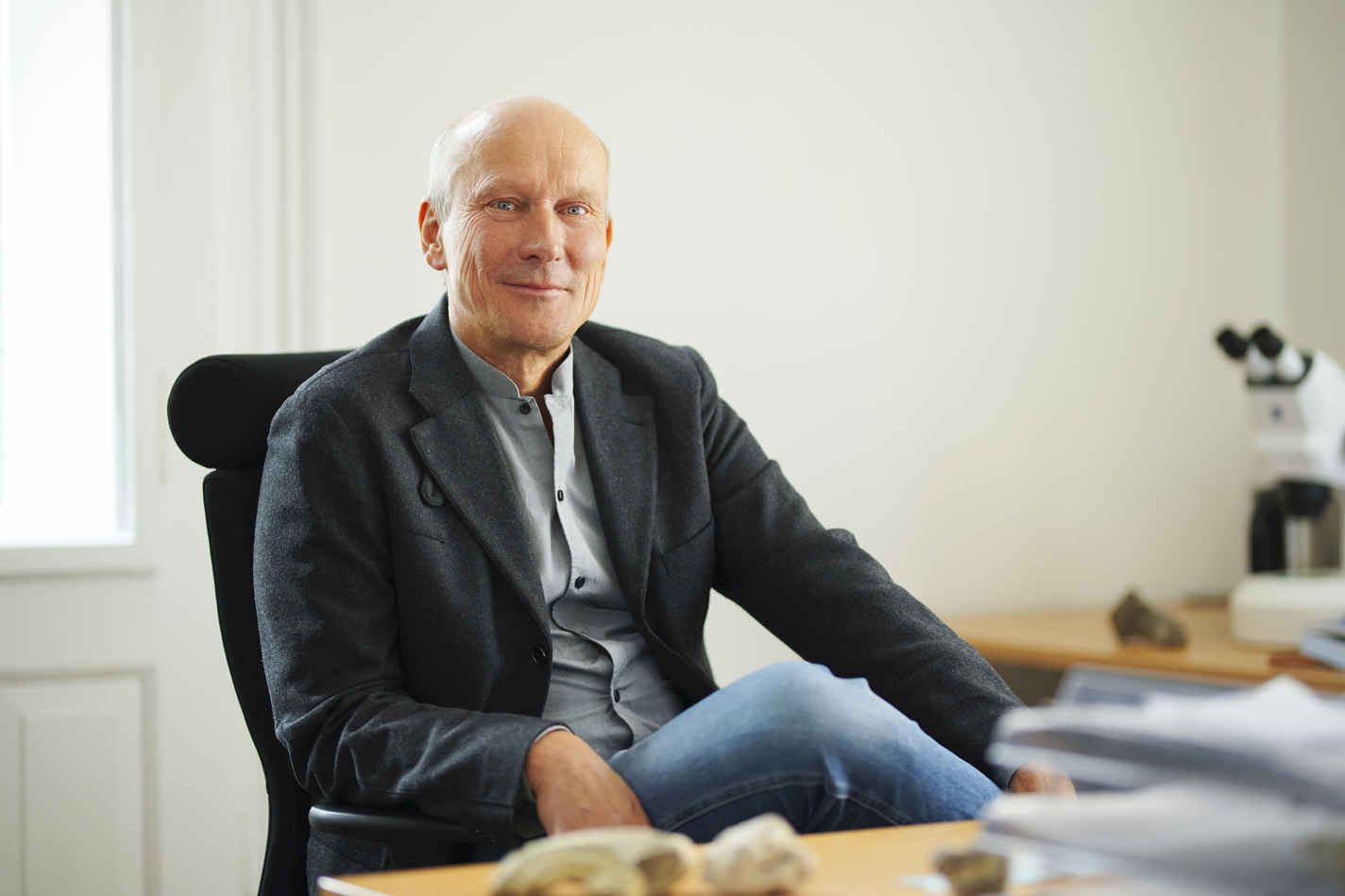
© David Hartfield
Professor Dr Wolfgang Kießling holds the Chair of Palaeoenvironment at Friedrich-Alexander University Erlangen-Nuremberg. He is one of the leading experts on the effects of climate change on marine ecosystems in prehistoric times.
About the person
Prof. Dr Wolfgang Kießling was born in Coburg in 1965. He studied palaeontology at the Friedrich-Alexander University of Erlangen-Nuremberg (FAU), where he was awarded his doctorate in 1995. Following a research fellowship at the University of Chicago from 2000 to 2001, he completed his habilitation at the Free University of Berlin in 2005 and subsequently worked as a professor of evolutionary palaeoecology at Humboldt University and the Museum of Natural History in Berlin. In 2012, he returned to FAU, where he has since held the Chair of Palaeoenvironment. Wolfgang Kießling researches the effects of climate change on animal species and ecosystems over long time scales. His main focus is on the development and evolution of coral reefs. He was a member of the Intergovernmental Panel on Climate Change (IPCC) from 2016 to 2023 and was one of the lead authors of the 2022 IPCC report entitled ‘Impacts, Adaptation and Vulnerability’. Kießling is the most frequently cited palaeontologist in Germany. In 2026, he was elected a member of the Bavarian Academy of Sciences.
© Sven Stolzenwald
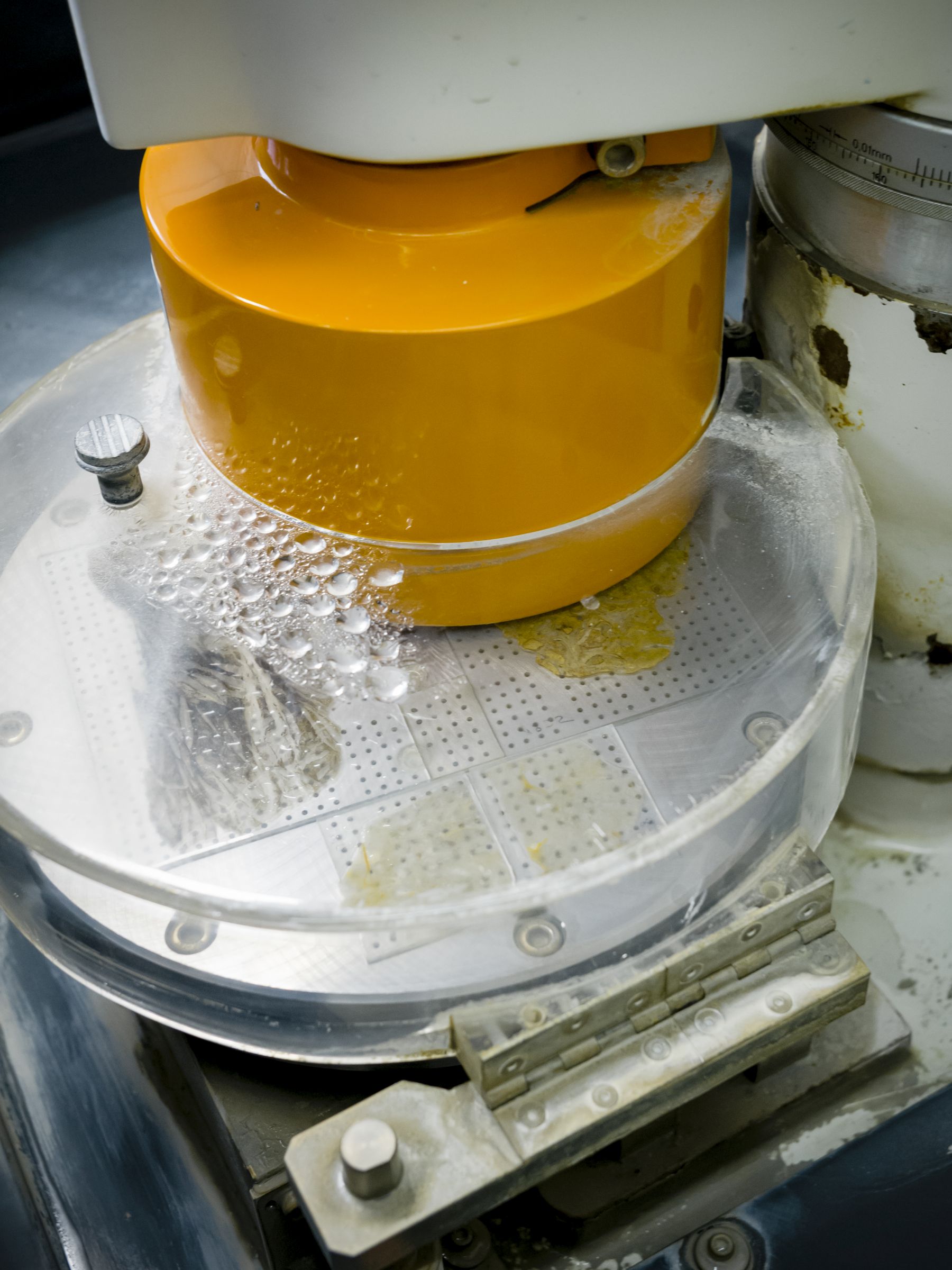
Preparation of thin sections of rock for subsequent microscopic analysis.
Further reading