“Wow, this could be something big”
Asymmetric organic catalysis? Nobel Laureate Benjamin List explains how he came up with this crazy idea and what it means for our future at the 2026 GDNÄ conference in Bremen.
Professor List, in December 2021 you were awarded the Nobel Prize in Chemistry. Has your life changed since then?
Yes, it has – especially at the beginning. TV appearances weren’t part of my normal daily routine before. Nor were the many public lectures, whether at ‘Jugend forscht’, the Kulturhaus Heidelberg or in university lecture theatres. The first two or three years were very intense. In the meantime, I’ve been able to get my life back to normal and finally have enough time again for my large research group at the institute in Mülheim. It’s not as if, as a Nobel laureate, you stop doing research.
What are you currently working on?
I’d like to highlight two projects. Firstly, we’re trying to remove the greenhouse gas CO2 from the atmosphere by breaking it down into O2 and C using sunlight and catalysts. The oxygen O2 returns to the atmosphere without any issues; what remains is carbon. This could be used as a kind of solar coal for all sorts of processes in the chemical industry. Surplus coal could be buried, for example in tunnels along the Rhine and Ruhr. The whole thing could help solve humanity’s energy problem and would be climate-neutral at the same time. We’re still facing a few tricky problems, but hopefully they’ll be solved in ten years’ time. Our idea isn’t entirely far-fetched; after all, CO2 splitting is already taking place on Mars, albeit only in small quantities.
And your second project?
We’re currently setting up a company that produces pure fragrances. At the molecular level, fragrances usually consist of two variants, known as enantiomers. They fit together like a picture and its mirror image, but have biologically different effects. The original might smell of mint, for example, and the mirror image of caraway – together they make a strange mixture. In industrial production, therefore, the aim is to produce pure fragrances containing only one of these molecular twins. To date, this has only been possible using complex processes. With the help of our patents, production can be simplified and made cheaper. I think we’ll be able to start this year. I am a basic researcher, but getting to know the industrial world is exciting.
© David Ausserhofer
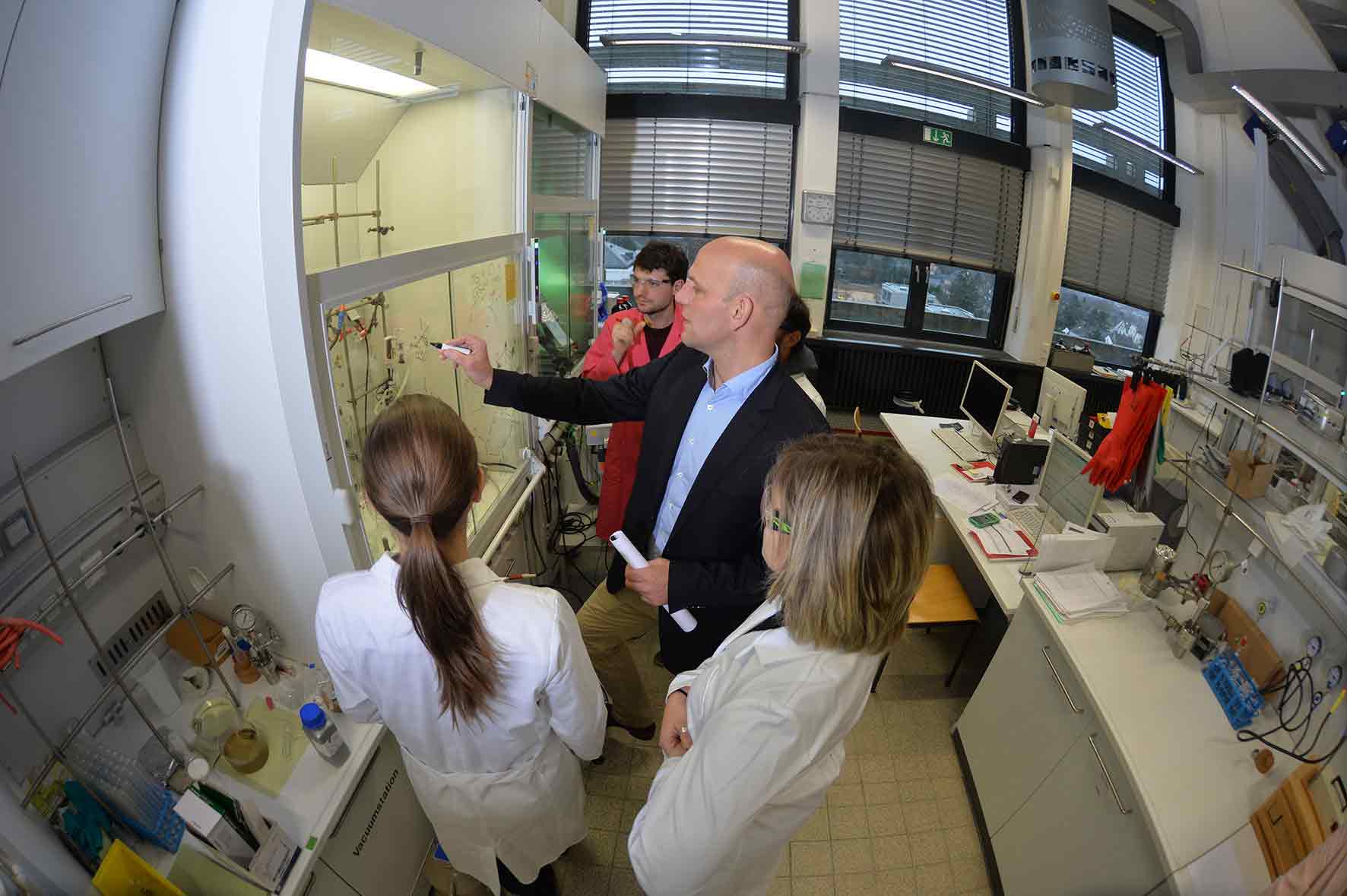
At work: Benjamin List leads a team of around forty researchers from all over the world. Teamwork is a top priority in the List research group.
You were awarded the Nobel Prize for the discovery of asymmetric organic catalysis. What makes this process so significant?
Catalysis as such is very, very important for our lives. Just one example: without the Haber-Bosch process, that classic example of catalysis, there would be no fertilisers. We wouldn’t then be eight billion people, but perhaps only four billion due to a lack of sufficient food. I consider catalysis to be humanity’s most important technology. Overall, there have already been several Nobel Prizes for catalysis research, and almost all of them were for metallic catalysts. Unfortunately, these also have drawbacks: many of them are expensive, rare and, on top of that, toxic. In 1999, I experimented with a small molecule, the amino acid proline, and discovered that it not only acts as a catalyst but also specifically produces the desired enantiomer. When I published this in early 2000, it came as a huge surprise to the scientific community: an organic molecule found in the human body acts as a highly selective catalyst – incredible!
You share the Nobel Prize with the Scottish-born US researcher David MacMillan, who arrived at similar results independently of you. Was the discovery in the air?
In hindsight, you could see it that way. David and I actually knew nothing about each other. We each made the crucial discoveries independently in 1999. When my very first proline experiment worked, I thought: Wow, this could be something big. Yet the idea itself wasn’t actually that new. Other chemists had tried it too. When the initial experimental results from the 1960s and 1970s weren’t really understood, interest in it waned. David MacMillan and I then tried a different approach and succeeded. Many chemists at the time rubbed their eyes in disbelief and asked: How could we have overlooked this?
@ David Ausserhofer
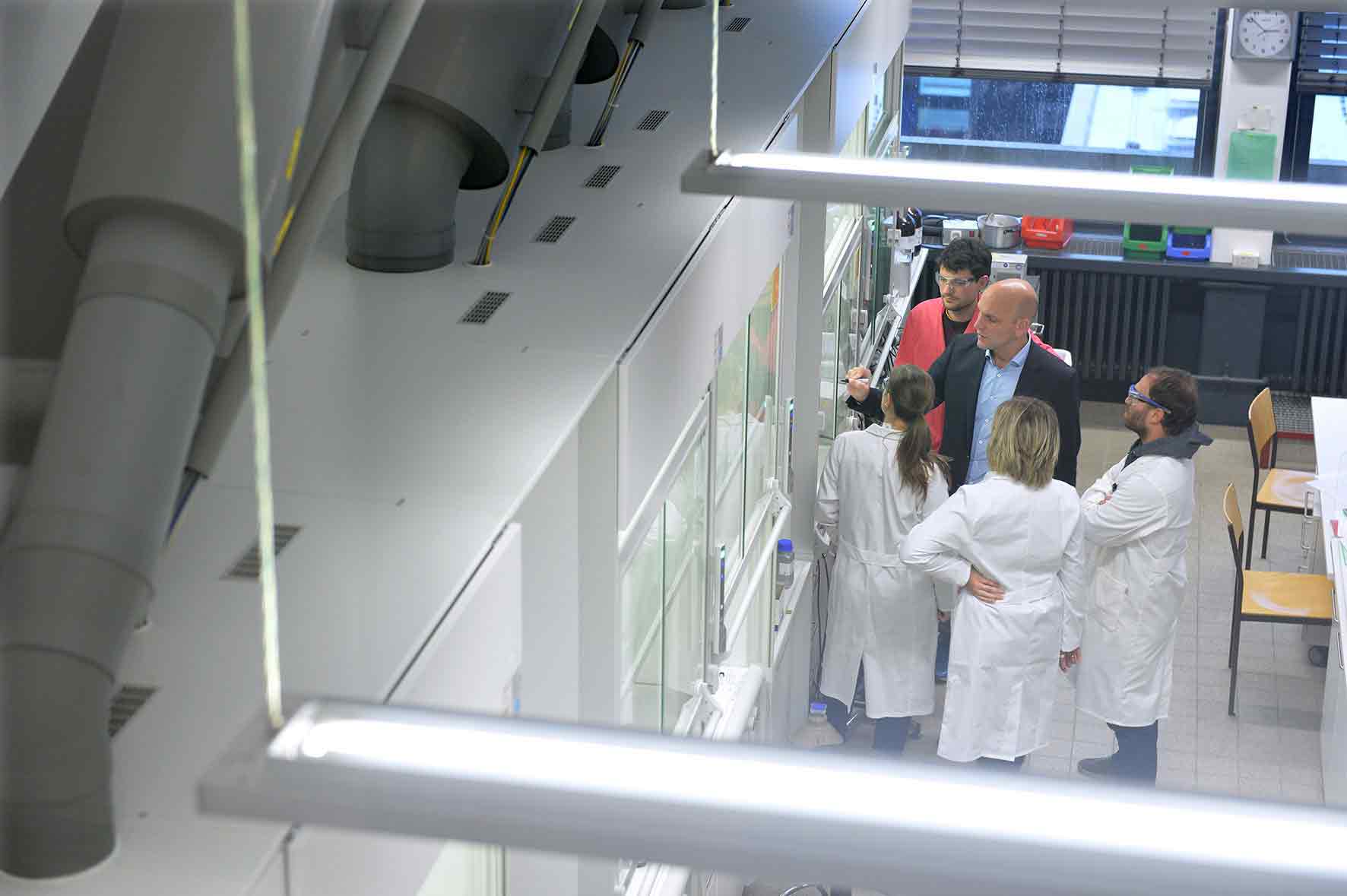
A scene in the laboratory of Benjamin List’s ‘Homogeneous Catalysis’ department at the Max Planck Institute for Coal Research in Mülheim.
Is organocatalysis used in industry today?
Yes, in many fields, including the production of medicines. One example is darunavir for the treatment of HIV. The active ingredient, a so-called protease inhibitor, prevents the AIDS virus from multiplying in infected people. The World Health Organisation has included it on the list of essential medicines.
Is more public funding needed for catalysis research?
Yes, that would be money well spent. At present, we are lagging behind in artificial intelligence, quantum and fusion technologies, far behind the US and China. Catalysis is not as popular, but it represents a major opportunity for Germany. We have a long tradition in this field and a great deal of expertise in the country.
Let’s take a look back: how did you come to become a chemist?
It all began when I was eleven years old. Together with two friends, I had set up a small laboratory in a basement in Frankfurt; we bought the necessary chemicals from a local chemist. At that time, I wasn’t yet taking chemistry lessons. Later, I had a few gifted teachers who encouraged me. But by then my interest in the subject was already very strong, and no teacher could have steered me away from that path.
The GDNÄ has its own youth organisation, the jGDNÄ. Is there anything you would advise young people interested in the natural sciences?
Follow your passion! Don’t let yourselves be swayed, even if your parents say: ‘I see you as a lawyer or a doctor.’ There are good career opportunities in the natural sciences, both in academia and in industry. The world has recognised how important research is. And it’s a stroke of luck if you’re interested in it. It gives me immense pleasure to be able to unlock a few of nature’s secrets and perhaps change the world in the process.
On 19 September, you will be giving the public Nobel lecture on the topic of ‘Organocatalysis for our world’ at the GDNÄ meeting in Bremen. What prior knowledge is needed to follow your talk?
An interest in the subject should suffice. I try to speak as clearly as possible.
What message do you want to convey to your audience?
Organocatalysis can be both basic research and application. Both are fascinating, and that is what I want to convey. And in doing so, I’d also like to promote the Max Planck Society a little. Its outstanding basic research is well known to many, but not everyone realises that it is also the most successful start-up organisation in this country. I have one more message: enthusiasm for what you do is important. Whether in research or in other areas of life.
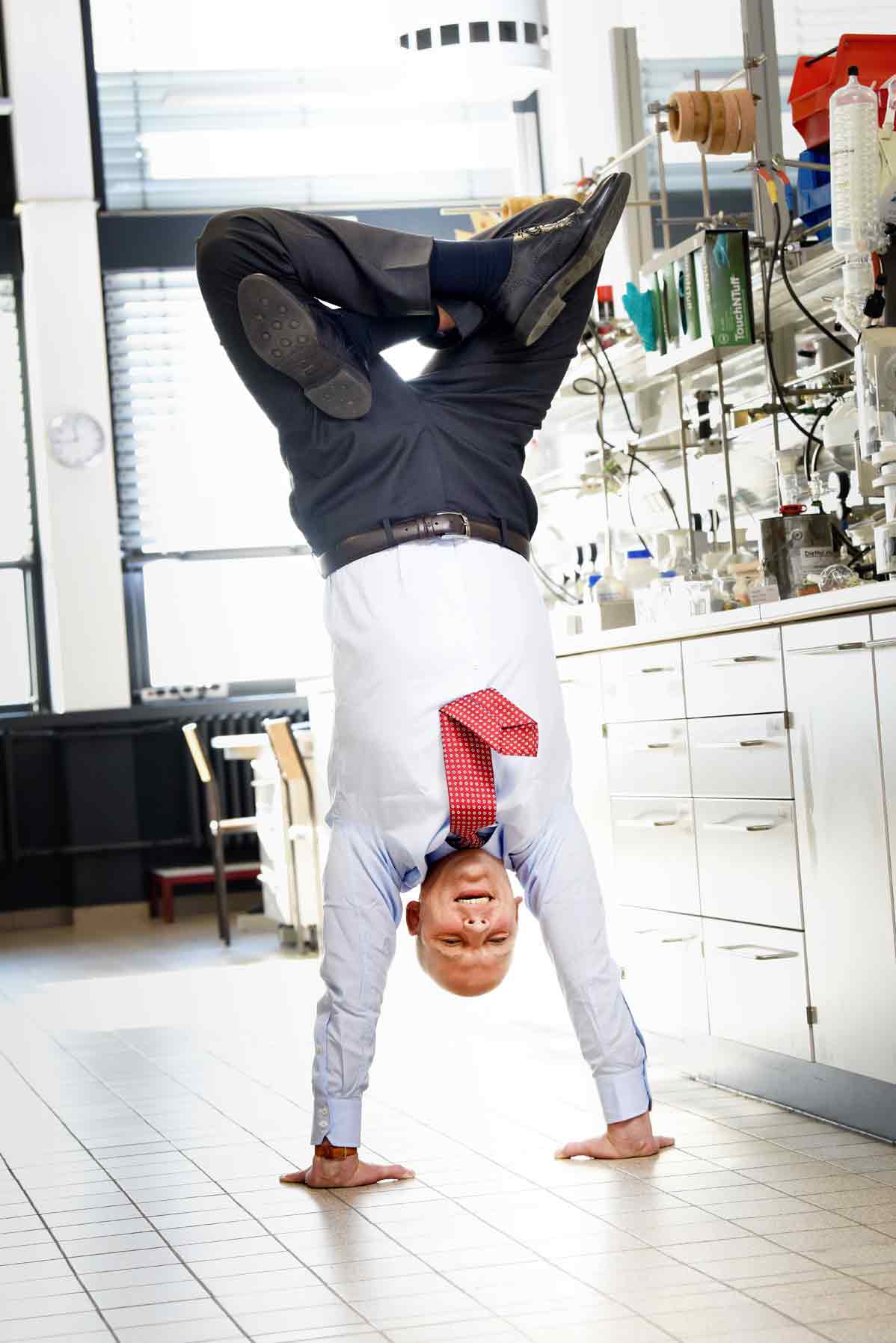
To conclude, may I ask you about a particular photo showing you standing on your hands with your legs crossed in the laboratory? How did that come about?
The photo was taken a few years before the Nobel Prize, during an interview with my fellow student Catarina Pietschmann, who works as a freelance journalist in Berlin. ‘You have to swim against the tide now and then,’ I’d said during the conversation, ‘maybe even stand on your head.’ That’s how the idea for the handstand in the lotus position came about. My wife was in the lab at the time; she held me up. I can’t manage a handstand on my own just yet.
Do you practise yoga?
Yes, yoga is important to me for keeping my mind fresh. I’ve been doing it for many years, one to two hours a day and mostly without instruction. I’ve got the hang of it a bit now.
@ Henning Kretschmer
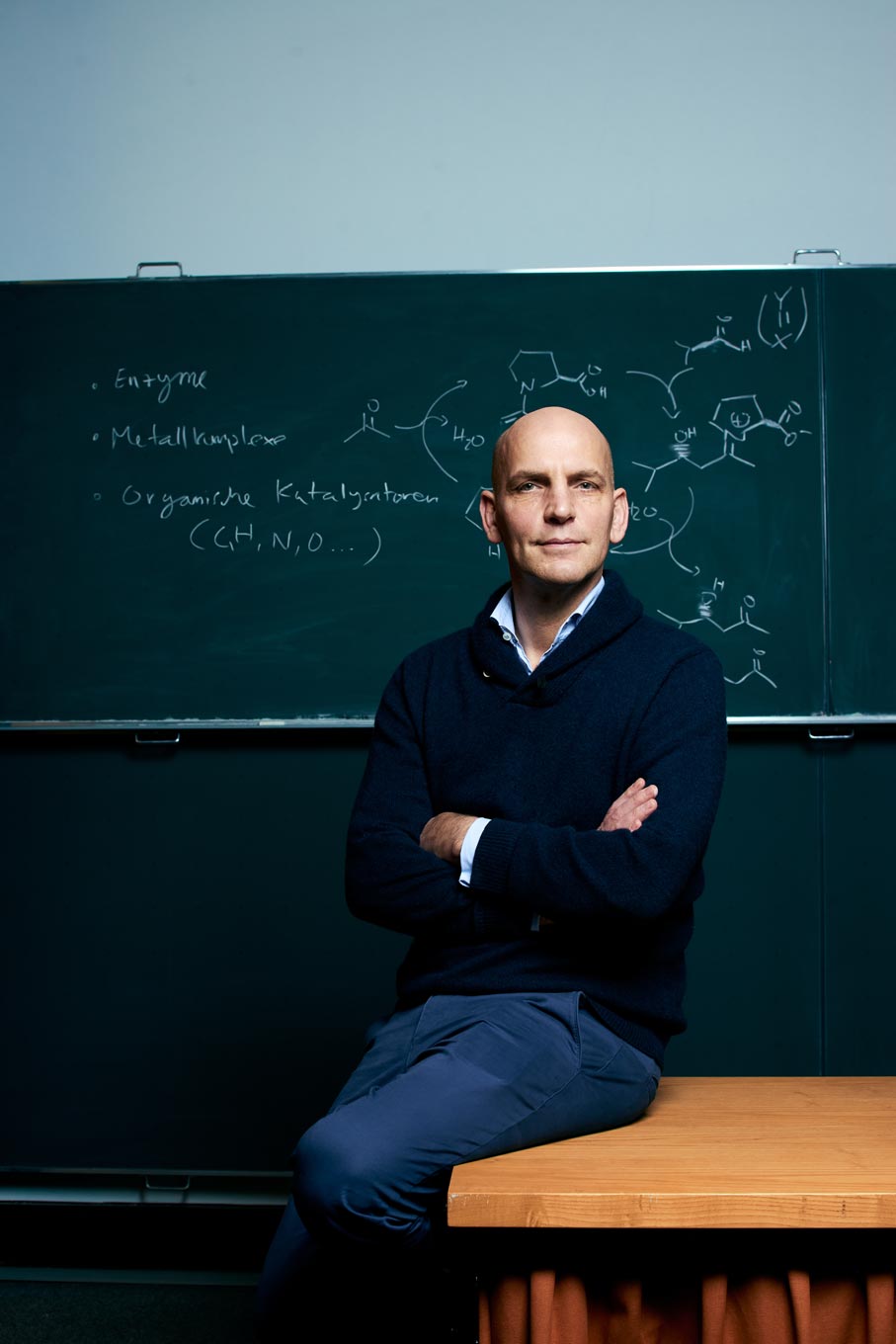
Prof. Dr. Dr. h.c. Dr. h.c. Benjamin List is Director of the Max Planck Institute for Coal Research and a Nobel Laureate in Chemistry.
About the person
Prof. Dr. Dr. h.c. Dr. h.c. Benjamin List is a chemist and one of the directors at the Max Planck Institute for Coal Research in Mülheim an der Ruhr. There he heads the Department of Homogeneous Catalysis. He is also a professor of organic chemistry at the Universities of Cologne and Hokkaido.
Benjamin List was born on 11 January 1968 in Frankfurt am Main. As the child of a family of scientists and artists, he spent his childhood and youth with his mother and two brothers. He completed his degree in chemistry at the Free University of Berlin in 1993. In Frankfurt am Main, he was awarded his doctorate in 1997 with a thesis on the synthesis of a vitamin B12 semicorrin. In 1997, Ben List, as many people call him, moved to the USA to conduct research at the Scripps Research Institute in La Jolla, California, until 2003. Back in Germany, he led a research group at the Max Planck Institute for Coal Research in Mülheim an der Ruhr from 2003 to 2005. He has worked there since 2005 as Director and a Scientific Member of the Max Planck Society.
Benjamin List has received numerous honours, including Germany’s highest research award, the Leibniz Prize. In 2021, he was awarded the Nobel Prize in Chemistry, jointly with David MacMillan, who is the same age, for the development of asymmetric organocatalysis. In 2022, the Federal President awarded him the Grand Cross of the Order of Merit of the Federal Republic of Germany with Star.
@ Frank Vinken/MPG
A handstand in the lab: Benjamin List only does things like this for photographers. The photo was taken a few years before he won the Nobel Prize; he managed the pose with his wife’s help.
Further reading and listening